Setting the stage
Open university-industry collaboration platforms – such as the Structural Genomics Consortium, Open Targets, and Denmark’s own ODIN, Plant2Food, Bridge4Water and IBIS OIS – are precompetitive public-private partnerships that share a distinctive commitment to ensure that all research outputs go into the public domain. The Danish platforms also explicitly facilitate the co-creation of use-inspired basic research projects, i.e., research in Pasteur’s Quadrant. Moreover, participants cannot seek IP protection on those outputs. This means that anyone and any firm can, at least in principle, access and build on the outputs. The underlying logic is appealing: collaborate openly on foundational knowledge, and compete on its application.
But this rests on an assumption that has been tested surprisingly little, namely that firms can capture sufficient value from open collaboration, and that the benefits are not simply captured by those already best placed to exploit them. Large, research-intensive firms with strong absorptive capacity, for instance, are likely far better positioned than startups, who often depend on exclusivity and lead time to survive. The question, then, is not whether open collaboration works, but under what conditions it creates sufficient value for firms. That was the question put to the panel.
Each panelist had been asked in advance to complete two sentences: „Open university–industry collaborations create the most impact for firms when…“ and „They become a risk or liability for firms when…“ The opening statements that followed were more revealing in their differences than their similarities.
Where value is – and is not – created
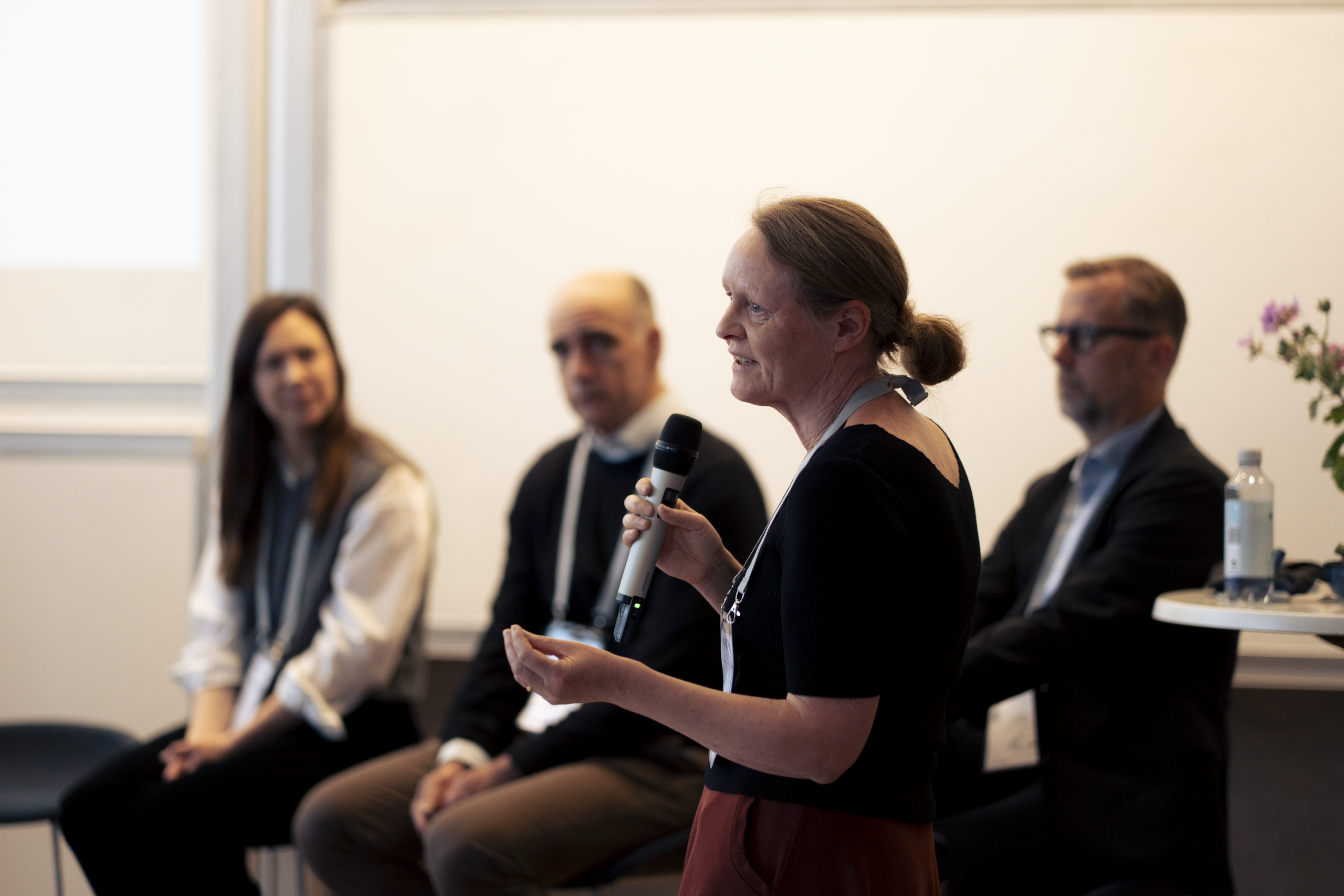
Karin Hultman argued that open collaborations are most valuable to firms when they address a shared scientific hurdle that multiple firms have a stake in resolving, but that no single actor can tackle alone. She drew on experiences from open university-industry collaboration programs that showed that, as industry partners became more comfortable pitching their own challenges, the focus on genuine, shared problems grew stronger.
Karina Fog emphasized that open collaboration can create value by reaching a higher level of scientific understanding that enables better evidence-based decisions earlier (e.g., should we pursue this protein as a target?). She also pointed out that companies sit on large reserves of unpublished knowledge, e.g., failed experiments, disease insights, negative results, and that open collaborations offer a vehicle to share such knowledge between firms and academia, which creates value for companies, even though it cannot be measured in any end product.
Markus Koester argued in favor of combining openness with what he called „competitive precision-driven models“, that is, transparent calls in which multiple academic teams address specific, well-defined challenges. Academics gain access to compounds, funding, and meaningful questions; pharma partners gain the ability to externalise hypothesis testing at scale and identify the strongest partners, without compromising their competitive position downstream.
All three of the first panelists argued that open collaborations can also become a liability for firms, when the boundaries between what is open and what is proprietary are unclear or start to blur, and when governance of the open collaboration is insufficient.
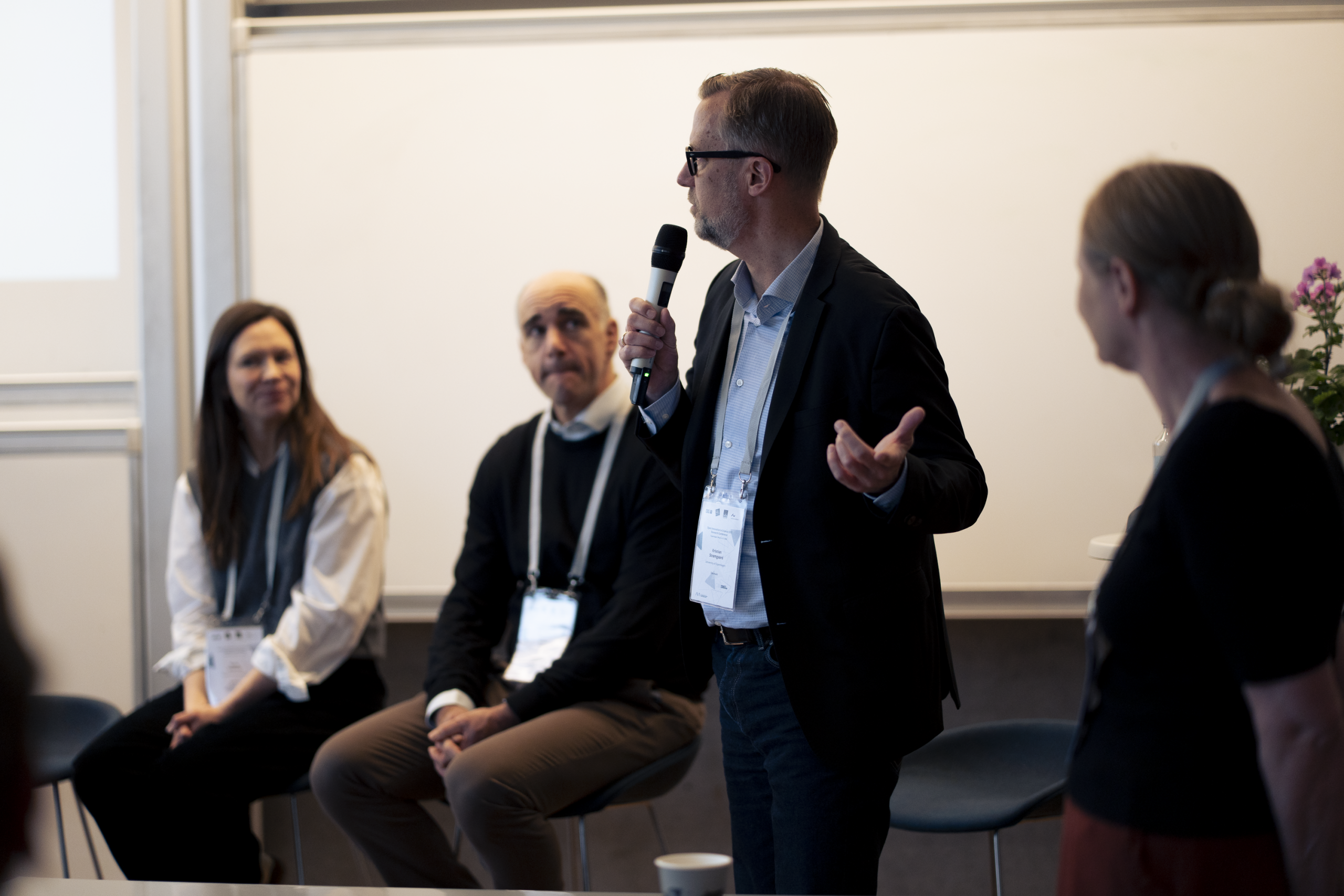
Kristian Strømgaard underlined the difficulties in finding the ‘right spot’ for open collaborations. In his experience, if a project is genuinely exciting for a company, it tends to get closed down rather than shared openly. What remains in the open space is often medium-priority for firms, which can lead to declining engagement from the firm.
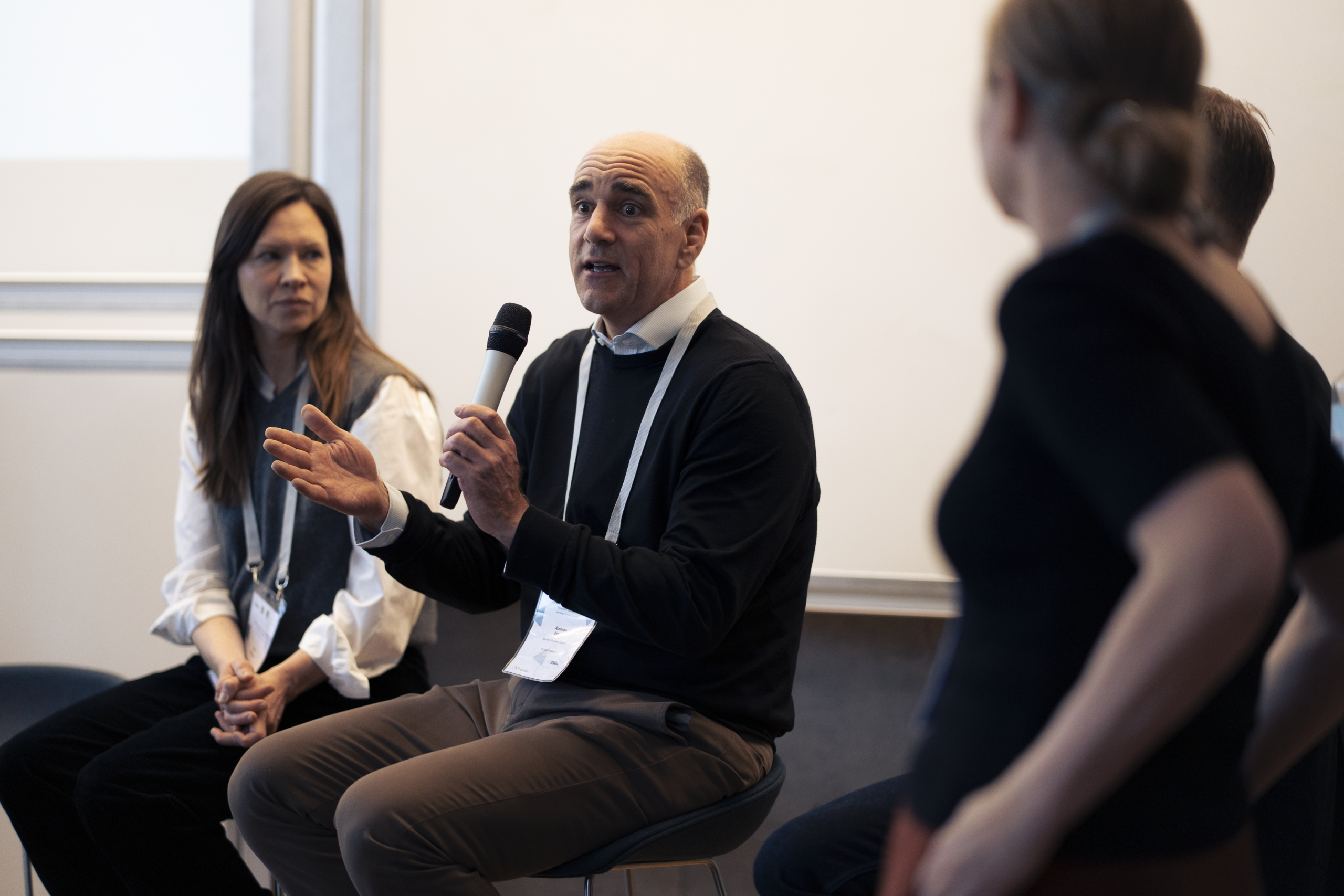
Ammon Salter noted that the open collaboration models discussed in the session stem largely from the pharmaceutical sector, where the appropriability regime allows firms to patent the molecule while openly sharing much of the upstream biology — a distinction that does not translate easily to other sectors. Both he and Kristian Strømgaard also emphasized the importance of low transaction costs, clear governance structures, and “plug-and-play” legal frameworks for making open collaboration attractive to firms in practice. One reason pharmaceutical-sector models have proven relatively successful, they suggested, is precisely because participation is often operationally straightforward: firms know the rules upfront, IP boundaries are clear, and collaboration can be initiated without lengthy negotiations.
Ammon Salter also pointed to the risk of „innovation theatre“ which can occur when companies use the language of openness to access public funds that subsidise R&D they would have needed to do anyway, raising the question of when these arrangements create genuine value.
The audience weighed in
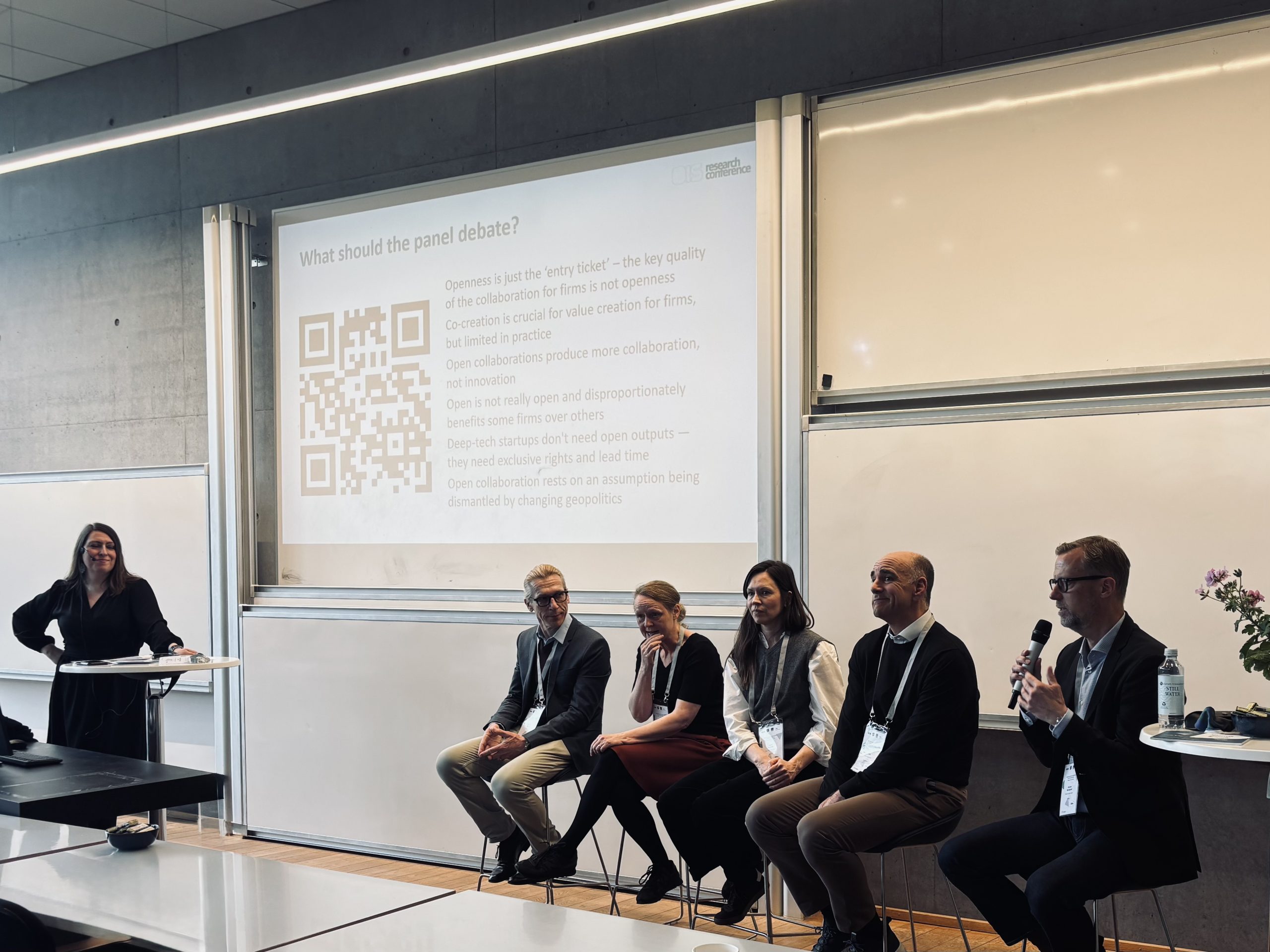
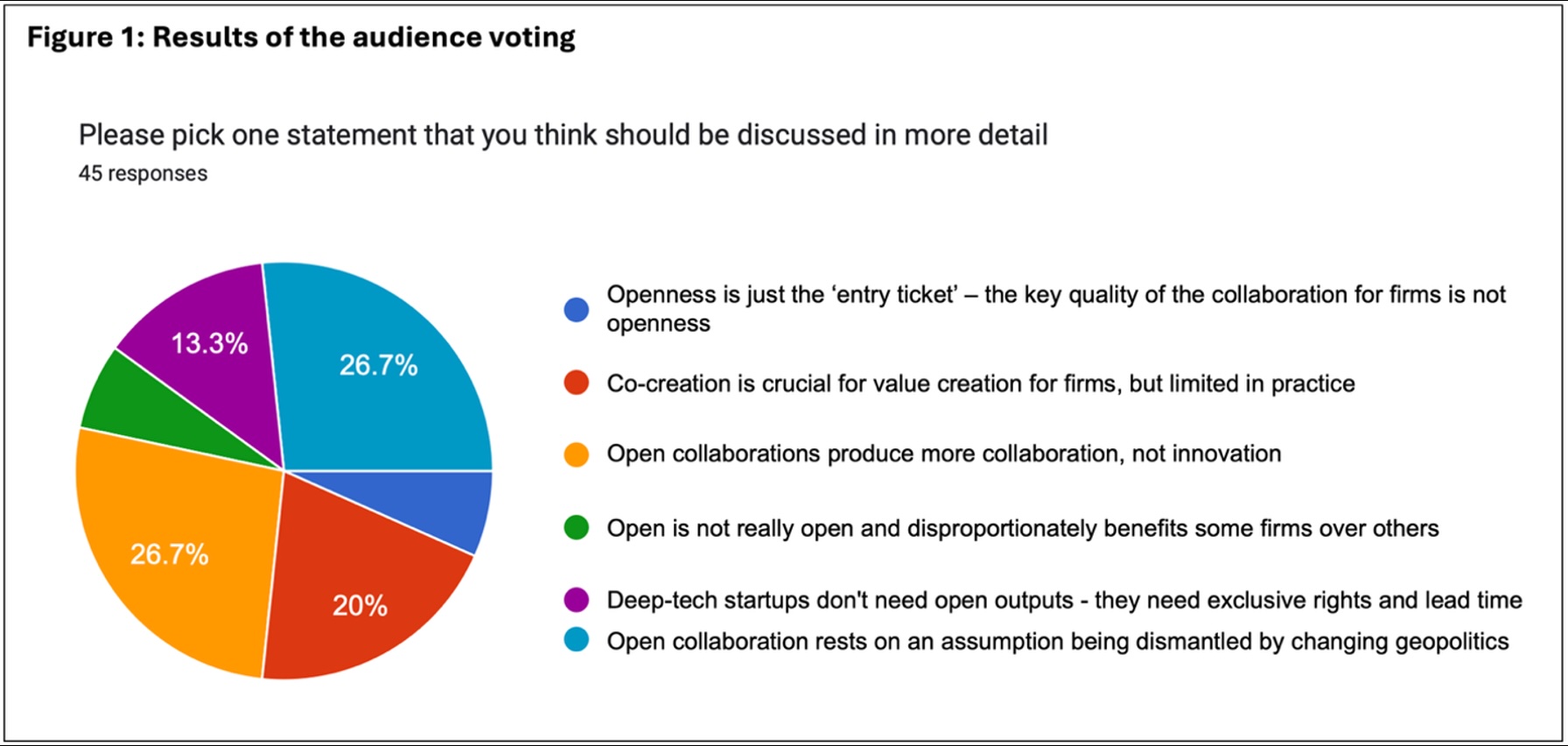
In moving from opening statements to the second half of the session, the audience were presented with six pre-prepared provocations and asked to vote online for those they most wanted the panel to address (Figure 1).
The three statements selected by the audience – and subsequently addressed – were, in order of priority:
- T
 he impact case for open collaboration rests on an assumption thatis quietly being dismantled: that foundational knowledge can flow freely across borders. Growing geopolitical tensions and an intensifying global innovation race will force firms and governments to think twice before placing their best science in the public domain — and that pressure will erode the very openness these platforms depend on to deliver impact
 - Open university–industry collaborations don’t produce innovation — they produce more collaboration. If we measure impact through spinouts and in-licensing deals, most of these platforms will look like failures. The honest metric is follow-on research partnerships.
- Many open collaborations claim to be co-created with industry. But, in practice, they are often academic research projects with a veneer of industry involvement. Until more firms put skin in the game and co-own the research agenda — not just co-sign it — the outputs will remain too early-stage and too generic to truly drive either corporate innovation or deep-tech startups.
How changing geopolitics can affect firms’ open collaborations
In discussing how the changing geopolitical context may affect open collaborations, Karina Fog acknowledged that it may indeed have a negative effect, begging the question of how to keep collaborations open in a world with ever more guardrails. Karin Hultman argued that geopolitical pressure makes international open collaboration more necessary, not less. Markus Koester suggested that open platforms might function as „beacons of hope“, keeping minimal channels of communication alive precisely in those areas where everything else is becoming closed and regulated. Ammon Salter added that open collaboration platforms may also generate a different kind of value under such conditions: by creating shared scientific foundations and standards that are recognised as legitimate across multiple stakeholders and countries. In this sense, openness may not only facilitate collaboration directly, but also create a form of “soft power” that helps sustain the legitimacy of continued international scientific cooperation.
But Karin Hultman stressed that adjustments are needed; for instance, philanthropic foundations are already thinking about regional models as a way of maintaining collaboration in a more fragmented world. She further stressed that openness only works when firms and researchers trust both the governance of the platform and the actors participating in it. As geopolitical tensions rise, establishing clear and proactive governance structures may therefore become even more important for sustaining open collaboration.
But Ammon Salter shared a cautionary tale: COVID. When the Chinese scientists who uploaded the viral genome made that act of openness possible, they arguably enabled every mRNA vaccine that followed. But within months, vaccine nationalism took over. The EU and UK fought bitterly over supply chains. Countries refused to recognise vaccines manufactured elsewhere. „Openness failed in COVID,“ he argued. His point was that we should not be naive about the fragility of openness when national interests assert themselves. Kristian Strømgaard echoed this concern with a recent example from his own experience, where a collaboration with a US partner was directly affected by concerns of how politics and geopolitics might affect the perception of the collaboration, ultimately limiting the degree of openness.
Measuring what actually matters
The next question concerned evaluation. Open collaborative platforms are under growing pressure to demonstrate that open collaboration eventually leads to concrete innovation results – spinouts, in-licensing deals, downstream products – from platforms that are fundamentally about early-stage, foundational research operating on timelines of fifteen to twenty years. Karina Fog captured the mismatch plainly: if the scientific question being addressed in an open collaboration today concerns whether a particular protein is a viable drug target, the drug that results, if one results, will not reach the market for two decades. Asking for measurable innovation impact in the short run is simply asking the wrong question.
But what are the right proxies? The discussion revealed that there is no settled answer. Karin Hultman pointed to ongoing efforts to explore both interim and long-term indicators of impact in the open collaborations funded by the Novo Nordisk Foundation, and highlighted examples of indicators such as whether companies change their development strategies based on outputs from open platforms, or whether negative results from collaborations inform decisions about what not to pursue. Karina Fog suggested something simpler but perhaps underused: the number and quality of informal, unfunded interactions between industry and academic scientists that persist after a formal collaboration ends.
Ammon Salter underlined the importance of evaluating these programmes the way you would evaluate any other policy instrument by collecting information on projects considered but not funded, and comparing performance against similar instruments with similar costs. He also emphasized the impact that such collaboration platforms have on training scientists to work openly: do these initiatives attract the best and brightest early in their careers, and does that early exposure change what they work on and how they work for the rest of their lives? „If that is something that can be achieved with these initiatives,“ he said, „then I don’t care about the rest of it.“
What should open platforms actually do?
The closing round shifted focus to the last question highlighted by the audience, focusing on how to ensure that companies are sufficiently engaged in open collaborations. Each panelist was asked to share their single most important recommendation for increasing firms’ value capture from open university-industry collaborations. Karin Hultman called for a sharper focus on impact proxies, to further understanding of where and why these models work. Markus Koester echoed this, adding that platforms need to define key success factors upfront and monitor them with the same rigour applied to any other strategic investment. Karina Fog encouraged participants to engage in conversations with firms, arguing that „You will discover that a lot more can be shared than you assumed.“ Kristian Strømgaard pointed to incentives: universities need to genuinely reward industrial collaboration, and companies need to build environments that sustain engagement beyond the initial enthusiasm. Ammon Salter stressed his previous points regarding the importance of rigorous studies of these platforms and understanding whether and how they change scientific trajectories.
The panel set out to ask when open university-industry collaboration actually creates sufficient value for firms, and returned no clear answer, reflecting the complexity of the theme, particularly as pressure bears down on these platforms – from geopolitics and from short-term impact demands. What the panel did achieve was creating a cleaner map of the terrain: where value is most likely to be found, and where open collaboration models are most vulnerable. And what the OIS research community needs to investigate if open university-industry collaboration is to deliver on its considerable promise. The work continues.