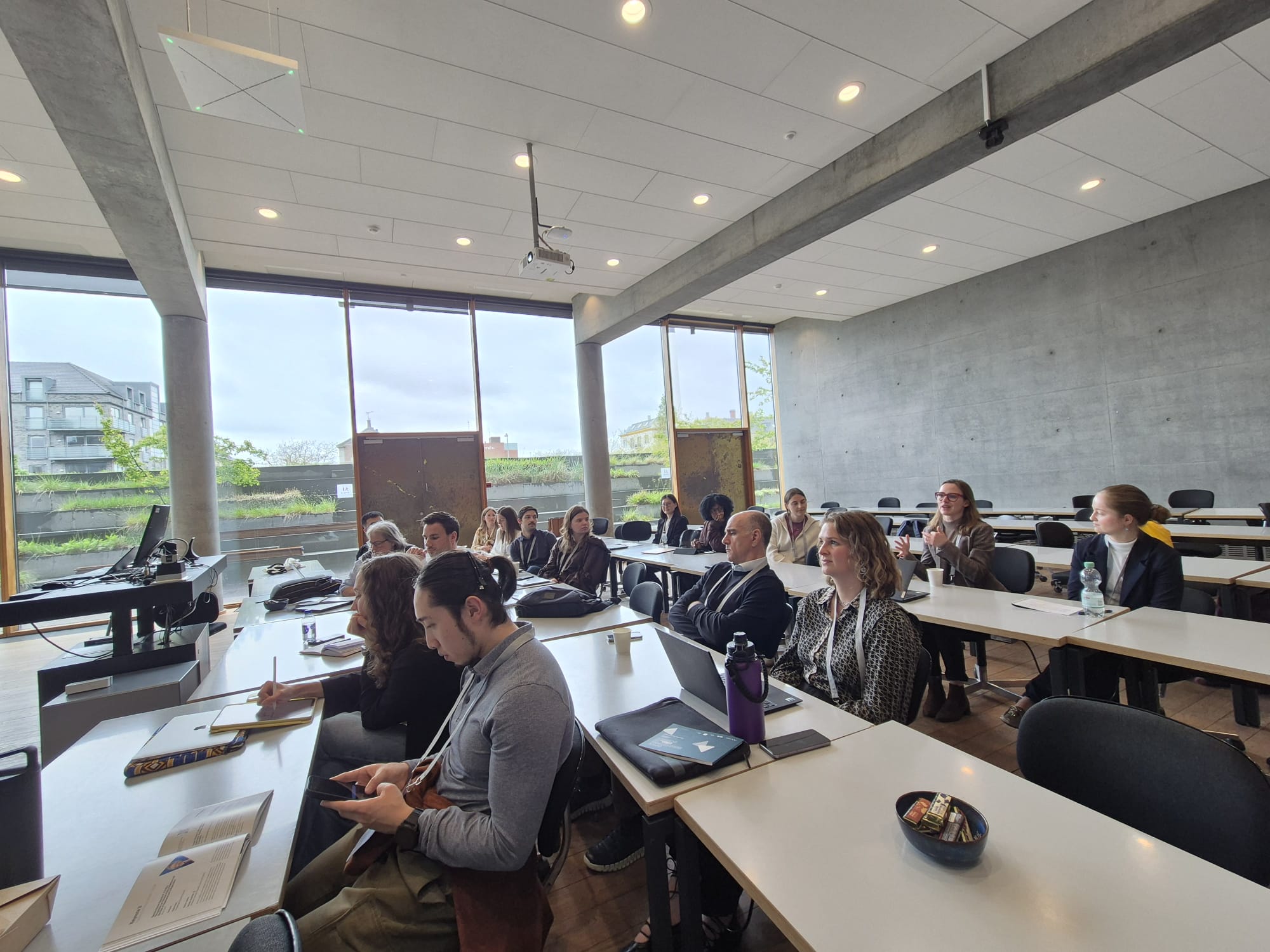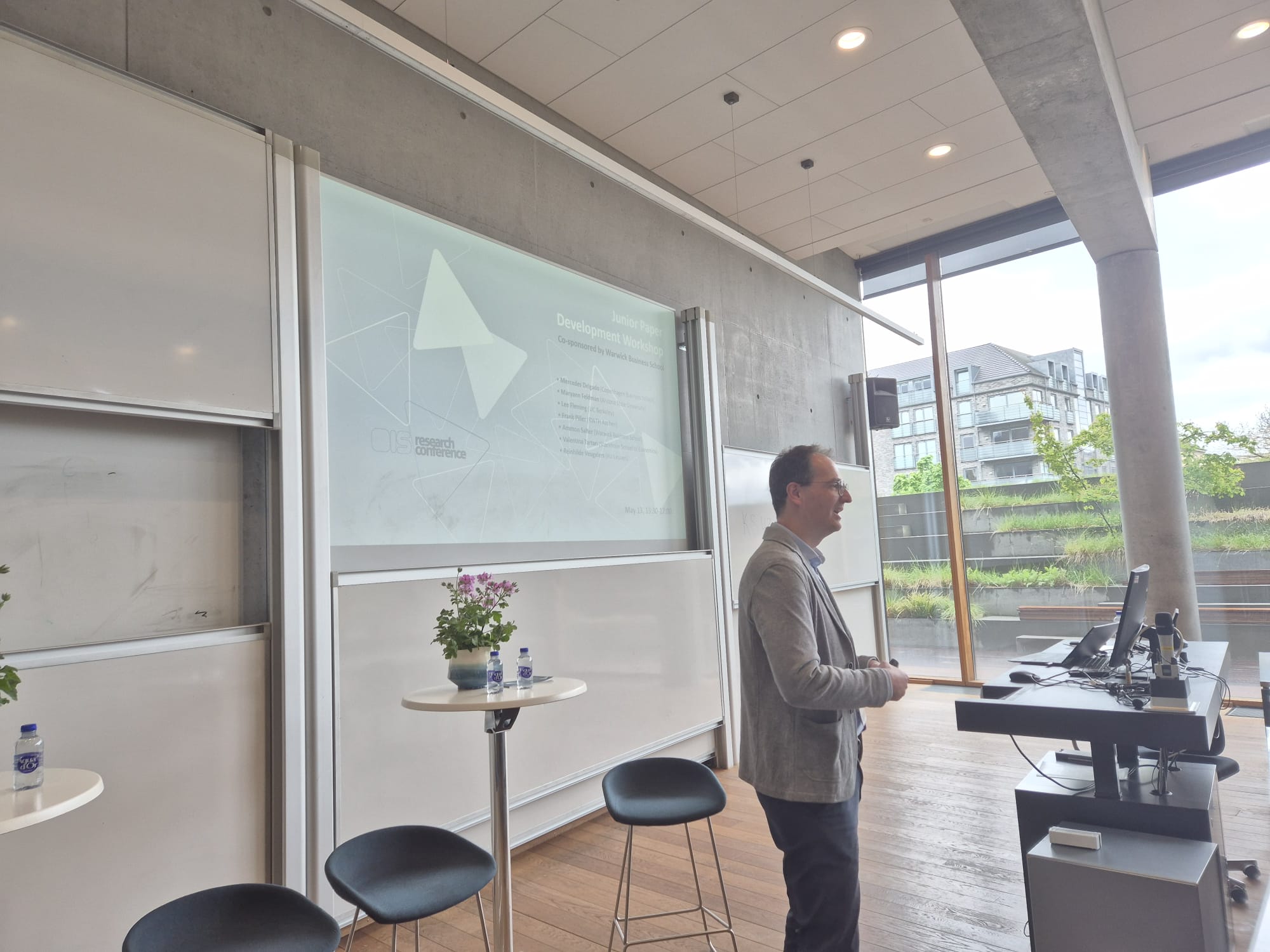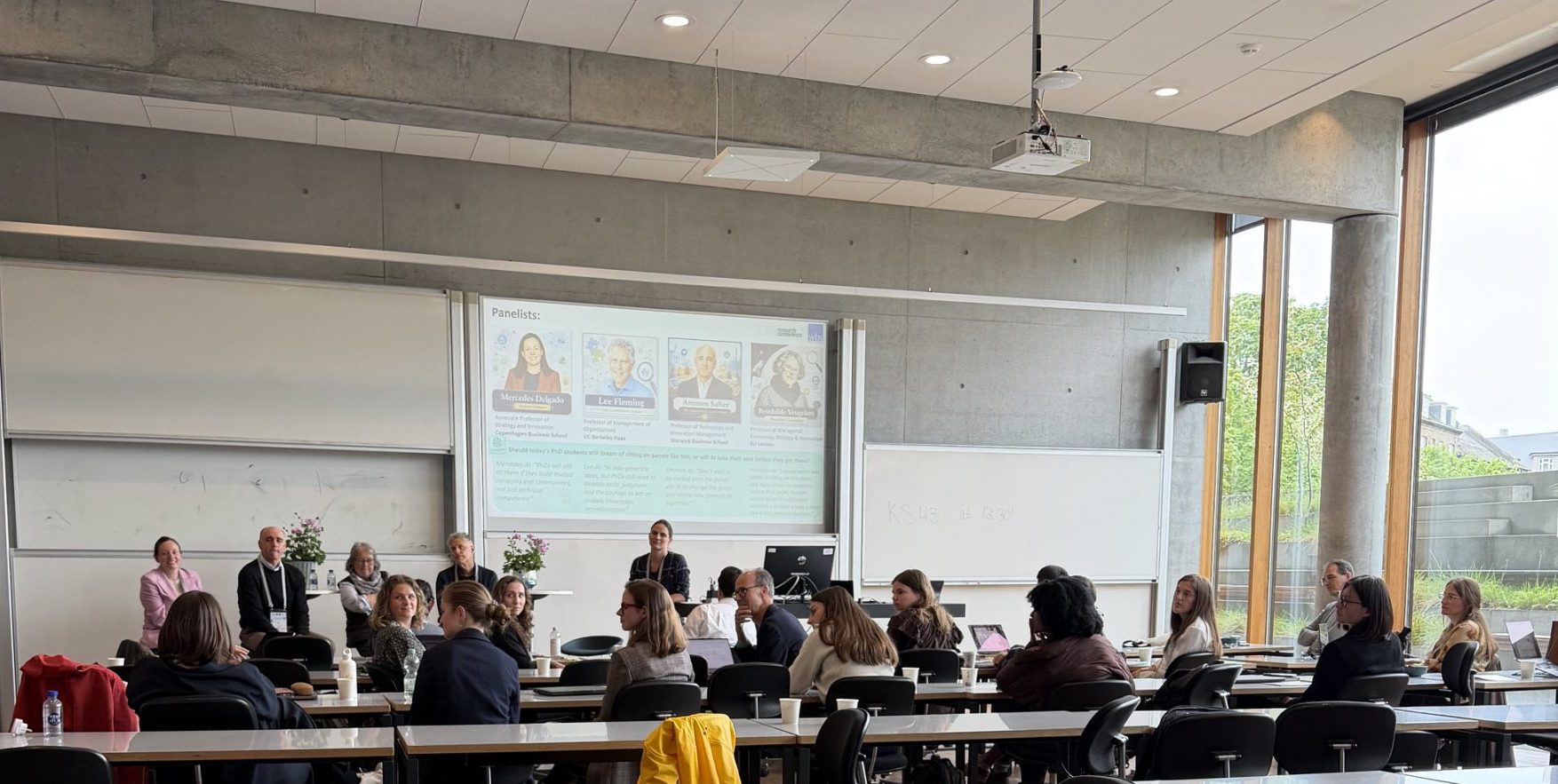
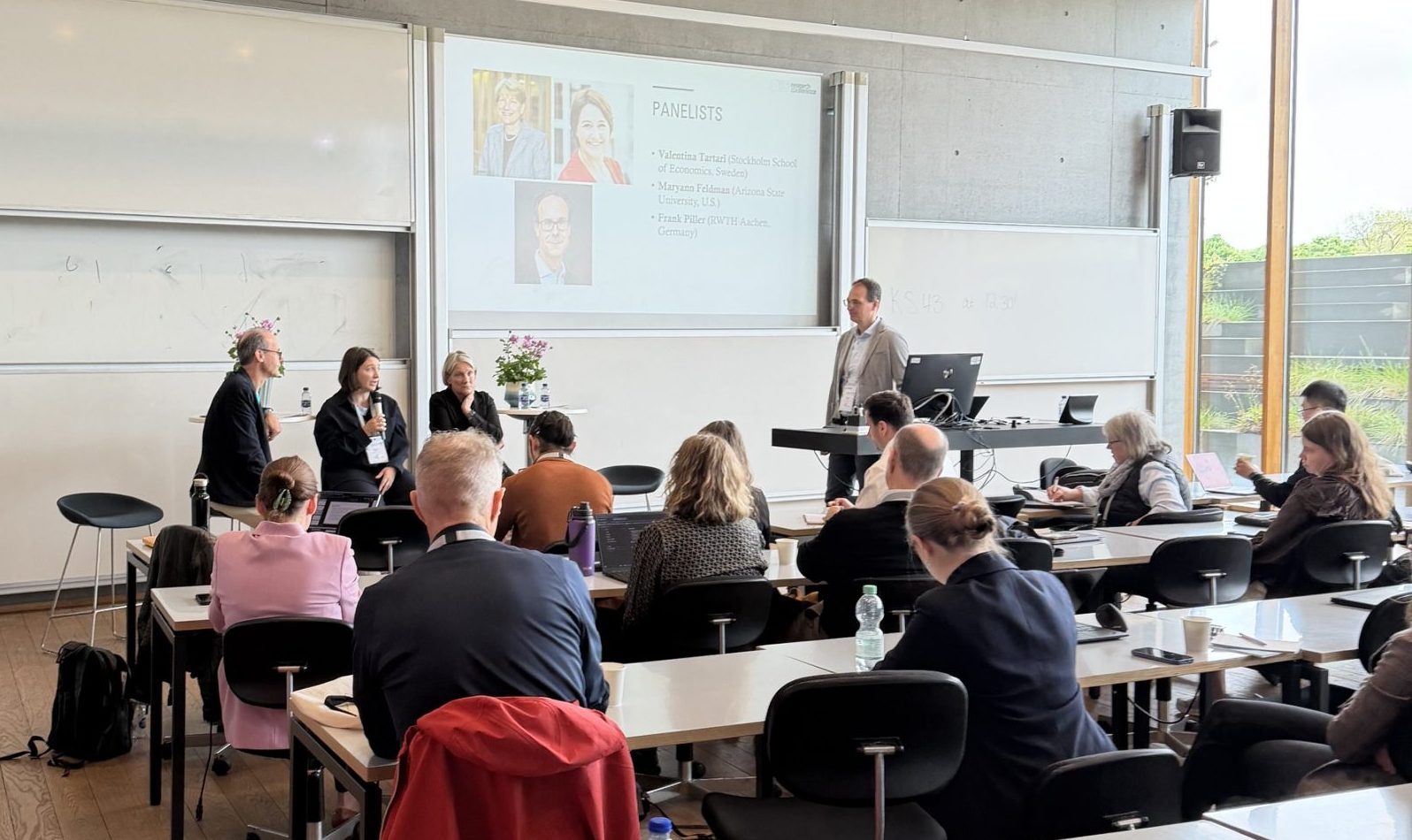
On May 13, 17 junior scholars from different disciplines and at different stages of their PhD journeys came together for an afternoon dedicated not only to improving papers, but also to reflecting on what it means to build an academic career in a changing scholarly system. One participant even brought their toddler along – by far the youngest attendee in the room and a wonderful reminder that academic communities are at their best when they make space for family life, too. The toddler also proved to be a critical audience for the speakers – something many parents will recognize  . The Junior PDW was organized around two panels, followed by small roundtable discussions with senior mentors. While at first glance, the two panels addressed different questions, we will see soon that they are deeply connected.
Panel 1: How can science studies be published in management journals?
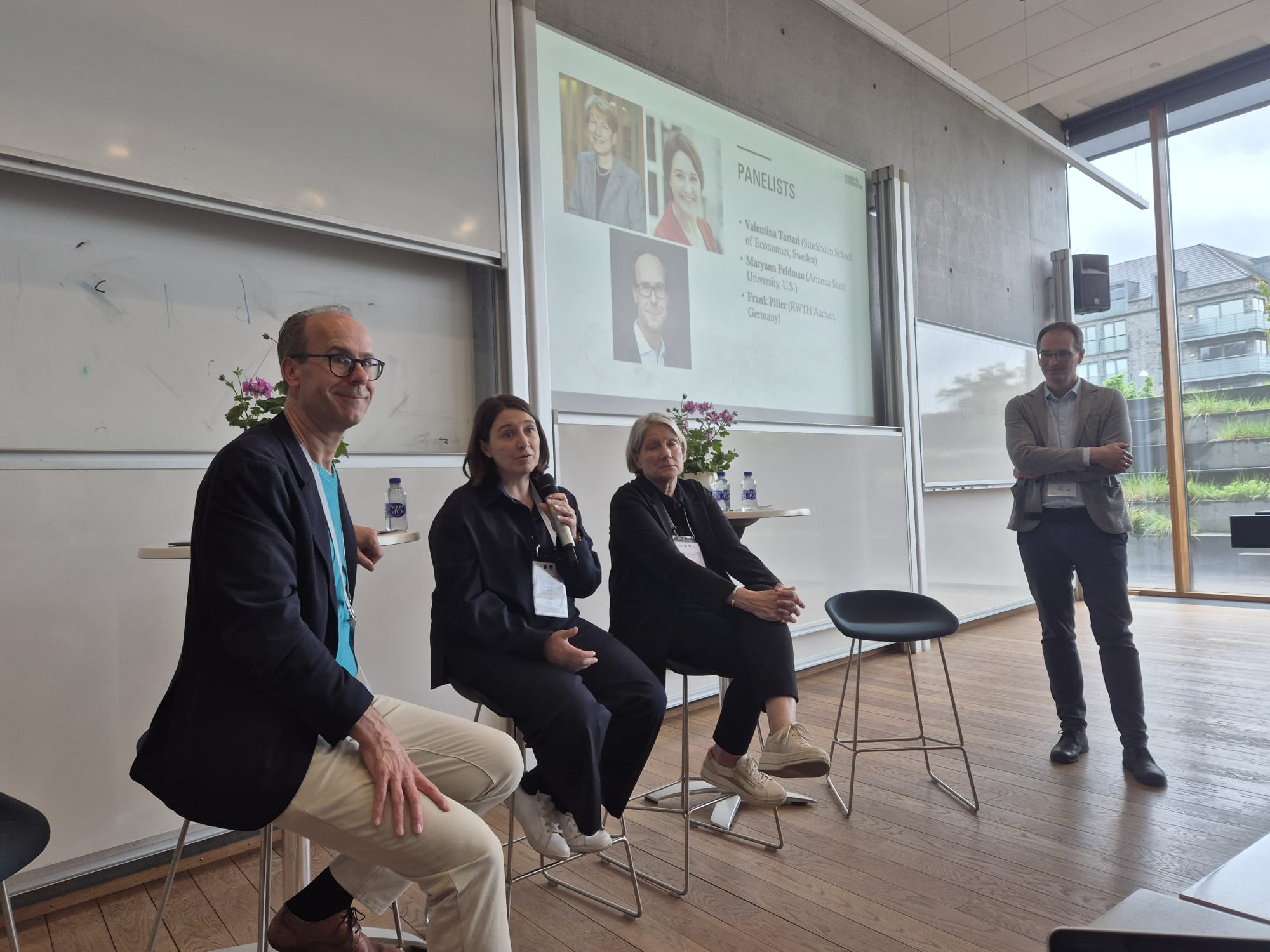
The first panel, moderated by Christoph Grimpe (CBS), and featuring Maryann Feldman (Arizona State University), Frank Piller (RWTH Aachen), and Valentina Tartari (Stockholm School of Economics), this conversation focused on one of the core challenges many junior scholars in the Open Innovation in Science community face: how to translate rich empirical and theoretical insights about science into contributions that build on and speak to management and organization scholars.
This is not simply a technical publication challenge but rather a challenge of translation and even publication culture. Science studies often examines knowledge production, ideation, collaboration, evaluation, incentives, openness, legitimacy, and the interplay between knowledge workers and institutions. These are deeply relevant to management scholarship. Yet publishing this work in management journals requires more than adding a managerial implications paragraph at the end. It requires junior scholars to make clear why science is not only an interesting empirical setting, but a powerful context for conceptualizing about organizing, innovation, strategy, and institutional change.
The panel therefore raised a much broader issue: How do ideas become legible across communities?
Panel 2: What will it mean to build an academic career in the age of GenAI?
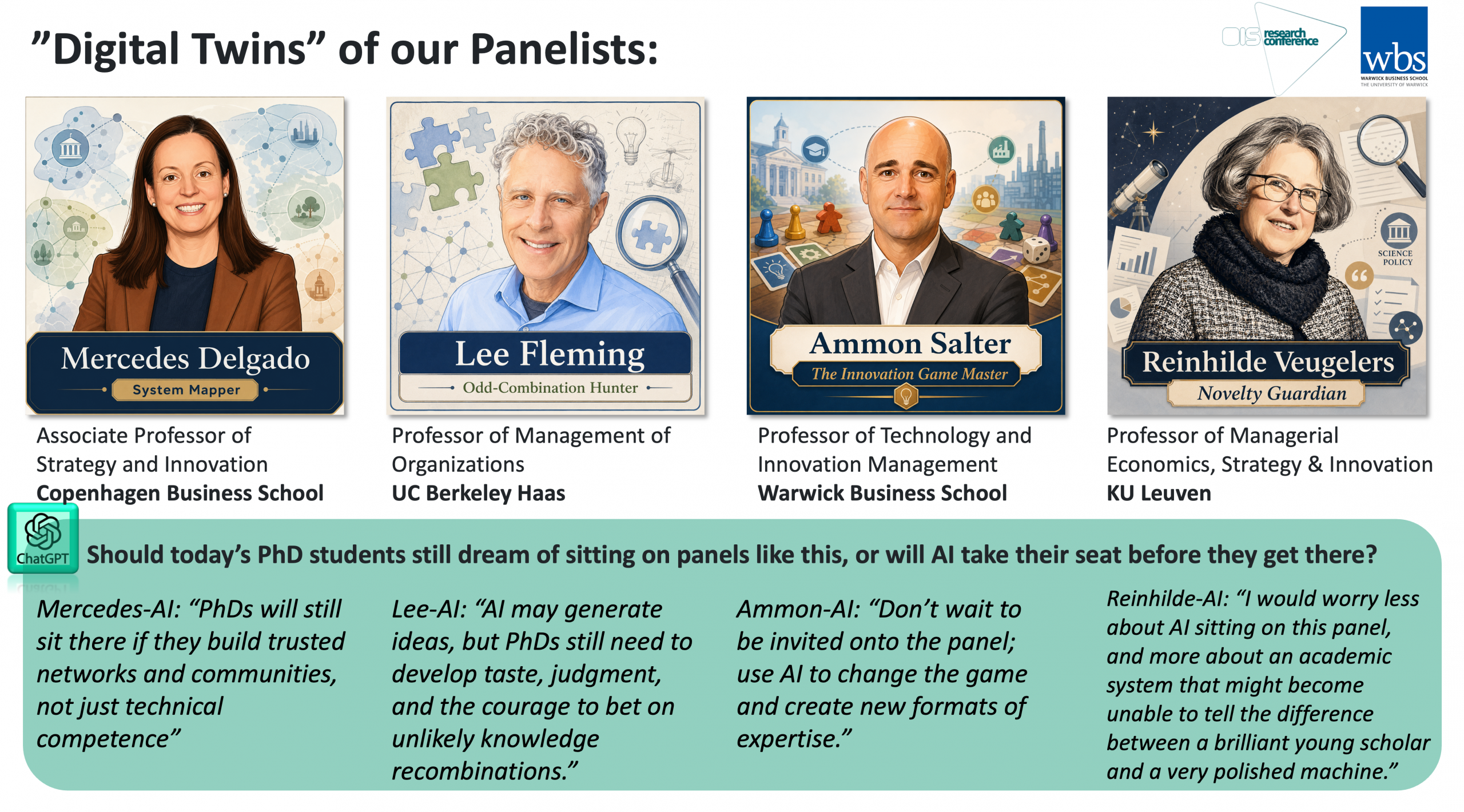
The second panel, moderated by Susanne Beck (WBS), shifted from the paper to the person. But for the kick-off we took a creative detour. Before the panel with Mercedes Delgado (Copenhagen Business School), Lee Fleming (UC Berkeley), Ammon Salter (Warwick Business School), and Reinhilde Veugelers (KU Leuven) had said a single word, we asked a question to their „digital twins“, created with ChatGPT based on their research profiles, and explored how the “twins” imagined each panelist might answer it (see Figure 1).
The opening question was deliberately provocative: Should today’s PhD students still dream of sitting on panels like this, or will AI take their seat before they get there? And they answered (purposefully provocative):
- Reinhilde-AI (aka Novelty Guardian): „I would worry less about AI sitting on this panel, and more about an academic system that might become unable to tell the difference between a brilliant young scholar and a very polished machine.“
- Lee-AI (aka Odd Combination Hunter): „AI may generate ideas, but PhDs still need to develop taste, judgment, and the courage to bet on unlikely knowledge recombinations.“
- Mercedes-AI (aka System Mapper): „PhDs will still sit there if they build trusted networks and communities, not just technical competence.“
- Ammon-AI (aka The Innovation Game Master): „Don’t wait to be invited onto the panel; use AI to change the game and create new formats of expertise.“
The reaction was immediate, with some heartfelt laughter. The panelists themselves, confronted with the task to reflect to what extent they have just been replaced by an AI-version of themselves, responded with a combination of amusement but also enthusiastically critical engagement. While overall there was surprisingly a lot of agreement with the AI statements, what created value for the audience was not the statements but the discussion they triggered amongst the panelists. And so, the real conversation began exploring: What will it mean to build an academic career in the age of GenAI?
After setting the stage rather playfully, the underlying concern of this question was serious: GenAI is changing the work of academia at remarkable speed. It can support writing, summarizing, coding, brainstorming, visualization, and feedback. For junior scholars, this creates new opportunities, but certainly also new uncertainties. If academic text can become more polished more quickly, what will distinguish a strong scholar from an off-the-shelve large language model?
The panel did not offer a simple answer, but many. It pointed toward a richer understanding of scholarly development. Junior scholars will still need networks and communities, because academia is not only an individual productivity game. They will still need judgment and taste, because generating ideas is not the same as knowing which ideas are worth pursuing. They will still need courage, because meaningful research often requires betting on uncertain, unusual, or unpopular questions before their value is obvious. And they will still need academic systems capable of recognizing substance, not just polish.
In that sense, the two panels were deeply connected. The first asked how science studies can become recognizable as a contribution to management scholarship. The second asked how junior scholars can become recognizable as scholars in a world where polished academic performance may become easier to imitate.
In hindsight, both panels point to the same underlying issue: recognition. How do ideas become visible as valuable? How do scholars become visible as scholars? And how can academic communities create the conditions under which early-stage work and early-career researchers receive the feedback they need before everything is already fully formed?
The (hidden) part nobody puts on a slide or in a paper
This is where the roundtables became so important. After the panels, the workshop moved into small-group discussions, with each senior mentor working closely with two or three junior scholars. Hence, the conversation moved from general advice to specific papers, dilemmas, and career questions.
For junior scholars, this kind of feedback is invaluable because it makes visible what is often hidden. How does a senior scholar read a paper? Where do they see the real contribution? What confuses them? What do they think should be cut, sharpened, repositioned, or made bolder? What kind of journal audience might understand the paper, and what kind of audience might miss its value? These are the questions that rarely appear in published articles, but they shape whether articles get published.
The roundtables also captured something central to Open Innovation in Science. Openness is not only about open data, open access, or open collaboration. It is also about opening up the processes through which scholarship is developed, evaluated, improved – and how junior scholars form their own scholarly identities. A generous academic community does not only celebrate finished work. It creates spaces where unfinished work can become better.
That may be one of the most important functions of a Junior Paper Development Workshop. It gives junior scholars access to the “backstage” of academia: the judgment calls, framing struggles, positioning choices, and mentoring conversations that often determine whether an idea travels. The future of academia will not be shaped by GenAI alone. It will also be shaped by the communities we build, the feedback cultures we sustain, and the criteria we use to recognize meaningful contributions.
At the OIS Junior PDW, this future felt less like an abstract debate and more like a room full of people “walking the talk”: asking questions, giving feedback, testing ideas, challenging assumptions, and helping each other see what a paper might become. Let’s build a scholarly community that helps even the youngest scholar in the room develop great ideas, conduct meaningful research, and submit their first paper to the OIS Research Conference in 2045! 🙂
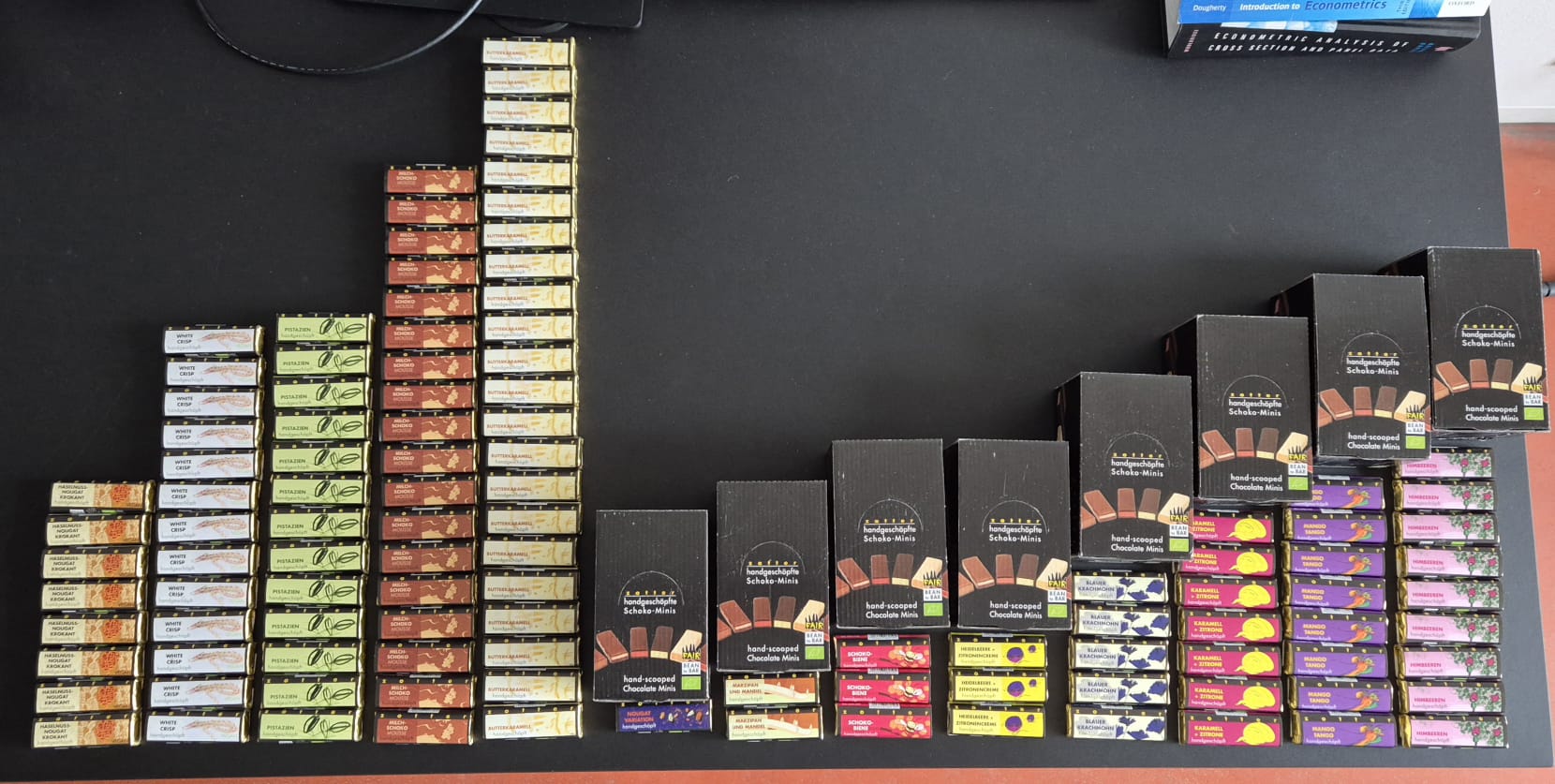
… and to continue the theme of “hiding” – we decided to publish this year’s Zotter chocolate statistics in a hidden way, too! But now, you have found it! Here is this year’s statistics: In total, over the 3 days, 813 chocolate bars were consumed by 117 participants, indicating a per capita chocolate consumption of 6.94872 chocolates. And the 2026 clear winner is Hazelnut-Nougat-Crocant, followed by White Crisp and Pistachio! It was a bad year though for fruity versions, particularly Raspberry, Mango-Tango, and Caramel-Lemon – let’s see if we will see them back in 2027. Thanks again for eating so enthusiastically and Warwick Business School for co-sponsoring our famous Zotter chocolate!
See you 10-12 May 2027 in Valencia – who knows, perhaps with a Horchata-Zotter Chocolate! ☀️